Wednesday, August 21, 2013

I believe in Guardian Angels...


I must have done something right....I am on my last day in Germany before heading to Strasbourg, France and I have to mention the Guardian Angels that have looked out for me during my time here.

Guardian Angel #1: During my time at Mark Anthony Brands in Vancouver I meet the export manager for Henkell, Deinhard and Schloss Johannisberg wines, Melanie Stein. She offered to book me into tours in her wineries in the Rheingau and to assist in whatever way possible. She wasn't kidding!
I was spending countless hours researching which other wineries in the Rheingau and the Mosel I should visit, where they were, was it possible for me to get there without a car, was there ferry or train service, what hotel to stay at etc....and I am not elaborating, the hours have been countless. Melanie was able to research and recommended wineries, passenger ferries and then referred me to her former colleague Matthias Walter who was the winemaker at Henkell for 10 years and is now living in the Mosel/Luxembourg area.

My Guardian Angel #2: I sent a note to Matthias and he helped to successfully arrange tastings at some premium estates (previously entered in my blog). He also attending some of the tastings, picked me up and dropped me off at my hotel. It was great having him at the tastings to ask more technical and challenging questions at the wineries. Matthias suggested that while in the Mosel I should see some of the other nearby regions to compare their vineyards, soils, and wine styles. Of course I'm interested in that! He suggested that I check out a day early from my hotel and we head to his home in the wine region of Luxembourg and then visit a friend of his that owns a winery in the Saar region (pronounced Zar). He arranged for me to stay above his father's restaurant were he has hotel accommodations and then drove me to the train station so to I could get to Koblenz. He was pleased to do it and enthusiastic to share the wine culture of his home.

Guardian Angel #3: I have a very good friend that lives on the west side of the Netherlands that drove into Germany to visit me for a girls long weekend. I met Jiska and her family when they were on a work exchange to Canada back in 2003. They moved back a year and a half later but have managed to visit each other a number of times since their move back. After leaving Luxembourg I took the train to Koblenz where I met Jiska and toured Deinhard (Koblenz), the Loreley rock (St. Goar), Montigny winery in the Nahe, Schloss Johannisberg (Rheingau) and the Rudesheim Wine Festival!

And a 4th just showed himself, the city bus driver. I showed up to Hochheim train station just this morning and it was like tumbling tumbleweeds blowing by. The nicest bus driver, with some broken english helped me get as close as possible to my hotel. He even went to the extent of getting out of the bus at one of the stops to run into 2 businesses to ask if they have heard of my hotel and give me further directions. Incredible! I'm safe and sound.

I cannot thank these angels enough for adding to my experience and the enjoyment of my time in Germany.

Some photos below of Melanie, Matthias and Jiska. Didn't have time to get one of the bus driver....


Monday, August 19, 2013

time to move it along....Dr Loosen and Thomas Haag

So many experiences to tell and to share, and so little time to blog so I can keep on touring! I went to Dr Loosen and Thomas Haag for my last day in the Mosel before I was whisked away by a winemaker. (more on that later!)
Dr Loosen has a presence in British Columbia where I resided last year and are involved in a joint venture making a Riesling in Washington State with Chateau St Michelle called Erocia. We stared the tasting with their second label Villa Wolf. This are affordable wines that show varietal typicity. My host was a Sommelier and an expert on food and wine pairing and was able to share a few tricks up his sleeve when it comes to pairing Riesling.
Thomas Haag produces only Rieslings at Schloss Lieser and comes from a lineage of highly acclaimed winemaking. His father is Fritz Haag and brother, Oliver Haag. They exercise spontaneous fermentation and are apart of the Grosser Ring: 31 vintners that are apart of the VDP. I found this interesting as it is a separate association to the Bernkastel Ring that I learned about earlier in the week.
I visited both wineries in the same day and keep in mind if you are to visit wineries in this region they mostly operate by appointment so book ahead.
Both of my visits were humble, personal and in beautiful settings. Wish I could have taken more pictures....
If you travel to the Mosel you will find that whomever you email to make an appointment with, you will be emailed back with a surname that is the same as the winery. This is not what I am familiar with back at home; wineries small enough that they are owned and operated by the same person or family. A nice personal touch.


Markus Molitor, Mosel

An exciting tasting at Markus Molitor in the MittleMosel comprised of tasting riesling wines of the same sweetness levels over a number of vintages and dry to sweet wines of various years. It was a highlight to have an opportunity to taste the rare Beerenauslese('06) and Eiswein ('07)! But before we tasted the whites we started with a vertical of their Pinot Noir years '08, '09 and '06. The '06 was a 100 point wine! The grape is actually Pinot Noir and not the typical Spätburgunder of the region. These are Dijon clones in a combination Chambolle Musigny and Gevry Chambertin. The wines showed like Burgundy with the hallmark of German acidity.
Marcus Molitor only exercises spontaneous fermentation for all their wine styles and the mandate for this family run winery is to help restore the wines of the Mosel to their former glory. They own 14 or more small parcels of land all over the region and hand harvest at crazy low yields between 10-55 hl/ha.
This winery doesn't do anything without giving 110%. Stunning building, tasting room, stemware and experience. I saw a few of their bottles while I was living in Vancouver and I would like to see more when I'm back in Canada!


Thursday, August 15, 2013

Dr Pauly-Bergweiler

A master in off dry and sweet Riesling wines. Only 1% of their vineyards are Pinot Noir. Since its a difficult grape to grow they have a great back up plan when it's not as ripe as it should be. They make a traditional method sparkling wine! Brilliant:)
The tasting room is located in central Bernkastel and the location of the wine production is in another village. My host was gracious enough to take me to the production facilities and their vineyards. Of the most famous, I'm sure you can guess, is the the Bernkasteler alte Badstube am Doctorberg (say that 5 times fast).
I have seen their wines in British Columbia but on this trip I was introduced to a new label style, clean and simplistic in addition to their traditional label with a picture of the estate. Below you will see fermentation tanks that are very small. They ferment their grapes all separately from all the different vineyards. For their trockenbeerenauslese they are half the size or even smaller!
In the winery cellar there is nothing there from before WWII since the French too it all....we did get to see an old bottle of 1967 Riesling that has been covered in mud. It doesn't happen often but there are times when the Mosel floods and gets into the cellars, which is what happened to this bottle below with all the mud on it.


Joh Jos Prüm

Outstanding wine! Fantastic balance between sugar and acidity giving lots of freshness. Located in Wehlen which is home to the famous Sundial vineyard, or Sonnenuhr in German. The village is marked with various sundials on house and on the wine press below.  Just about every Weingut, or winery, in Germany has a press in their front entrance to landmark themselves as a winery.


Mosel vineyard photos and wine region facts

During my time in the Mosel I will be visiting the following wineries:
Joh. Jos. Prum
Dr. Pauly Bergweiler
Markus Molitor
Dr. Loosen
Thomas Haag, Schloss Leiser 
But first I must tackle the steep slopes of the famous Doctor Vineyard and hike to the very top! 
Measured at 3.26ha and at a slope of 60-70 degrees with a ground of loose slate. I was able to pull myself up the slope now and again by grabbing onto the individual vine stakes. The vines are taller than me. You can't see anything but I did come across some vineyard workers that didn't cause me any trouble, and nor did I. I figure it was about 400m above sea level at the top. After climbing such a steep slope with loose soils how do you get down????? I'll figure that out later:)
I thought it might be easiest to make this an entry for those who are interested, especially wine students, about the viticulture and the Mosel in general with some point form facts....then follow it up with some pretty pictures:)
German wines can be difficult to understand. They are not the sweet wines that have gained a negative reputation in decades past. Focus has gone to turning back the clock to the former glory of dry wines from this region. The wine labels are complicated and to understand the various wine laws you almost need a doctorate! 
Let's start with the 'crus' of the Mosel: Bernkastel, Erden, Piesport, Graach, Zeltingen, Brauneberg. These crus are villages located in the middle of the Mosel and have the best reputation for their vineyards
Let's start with the 'crus' of the Mosel: Bernkastel, Erden, Piesport, Graach, Zeltingen, Brauneberg. These crus are villages located in the middle of the Mosel and have the best reputation for their vineyards.

Qualitatswein bestimmter Anbaugebiete (QbA),Qualitatswein mit Pradikat (QmP),Verbrand Deutscher Pradikatsweinguter (VDP) and the latest I learned about is the Bernkastler Ring. (internal swearing right now). Then you can add on all the different dryness and sweetness levels: trocken, halbtrocken/feinherb, hochgewachs, kabinett, spatlese, auslese, beerenauslese, eiswein, trockenbeerenauslese. After you get use to it, it's kinda fun to say these names:) oh, and their is Sekt, which is sparkling wine. 

Mosel region: near 9,000ha (under cultivation or total?)
Location: 50* N latitude. It's very difficult to grow grapes to ripeness this far north. What helps, is a long ripening season which is made possible by proper sun exposure, heat retention and reflection from the Mosel river and the schist soils, proper training systems and vine management by hand
Harvest: by hand and starting late October. Staggered harvest times depending on the sweetness levels and botrytis rot ripening. 
Vineyard threats: the wild boar! They love the sweetness of the grapes. Also, cool wet weather in this northern latitude. 
History of the Doktor vineyard: in the 18th century the Archbishop of Trier became deathly ill and was cured by a humle flask of Riesling from the Doktor vineyard and was therefore named after its remedial powers 
Grape varieties: Riesling (60%), Muller-Thurgau (15%), Pinot Noir (4%), Dornfelder (4%). The others are Elbling and Pinot Blanc
Alcohol range: 7%-12% for table Rieslings, excluding the sweet wines which can be even lower
Aging capability: can be 20, 30 years or longer. The wines have unbelievable structure, a backbone of minerality and superior acidity that give it's longevity.This is something that you will hear over and over again about Riesling from the Mosel.
Vineyard training: doppelbogen 'heart' shape style. Took me a long time to figure it out. Looking at it didn't help so I had to touch and feel the vine canes and follow their heart shape. I have some photos here but the ones with greenery on them are hard to make out the canes. 
Food pairings: fish, Asian dishes, poultry, salad, spicy dishes and the sweeter wines with mature cheeses, game or foie gras.


Wednesday, August 14, 2013

Azores to the Mosel Region, Germany


My next destination is one of the most famous wine regions of the world, the Mosel. I'm booked in to stay at Bernkastel which is the heart of the wine region and a little tricky to get to due to the contours of the landscape therefore the train cannot take you here. The Mosel River has some of the most dramatic bends  in all of Europe and is guarded on both sides by  60-70 degree sloping vineyards. Small German villages dot the shores with half Tudor houses and church spires rising above the roof lines.
So how do you get from the Azores to Bernkastel, Mosel, Germany? Try and give yourself lots of time! I flew on an early morning flight out of Sao Miguel, changed planes in Lisbon, landed in Köln (Cologne) and got a train to Koblenz. I picked Koblenz as it is located where the Mosel and Rhine Rivers meet. I didn't get in till 9:00pm and was glad I booked two nights so I could have a day in Koblenz. The train ride from here to Traben - Trarbach is 1 hour 40min and then that was the end of the rail line. You can go by a long and infrequent river ferry, or bus #333. It's a beautiful journey and hard to contain my excitement with the sight of the vineyards for the first time.
The bus dropped me at the tourist office and my hotel was located around the corner. If you come to Bernkastel, I recommend the Hotel Doctor Weinstube! All the character and charm you would expect from a German medieval winestube but with modern spacious rooms.
Bernkastel is quaint and full of charm and all the ladies are wearing dirndels! Over the bridge on the other side of the river is the village of Kues. There is plenty of walking to do here and every corner you turn there are more Tudor buildings, fountains and friendly people. There is not much English spoken so bring your phrase book.
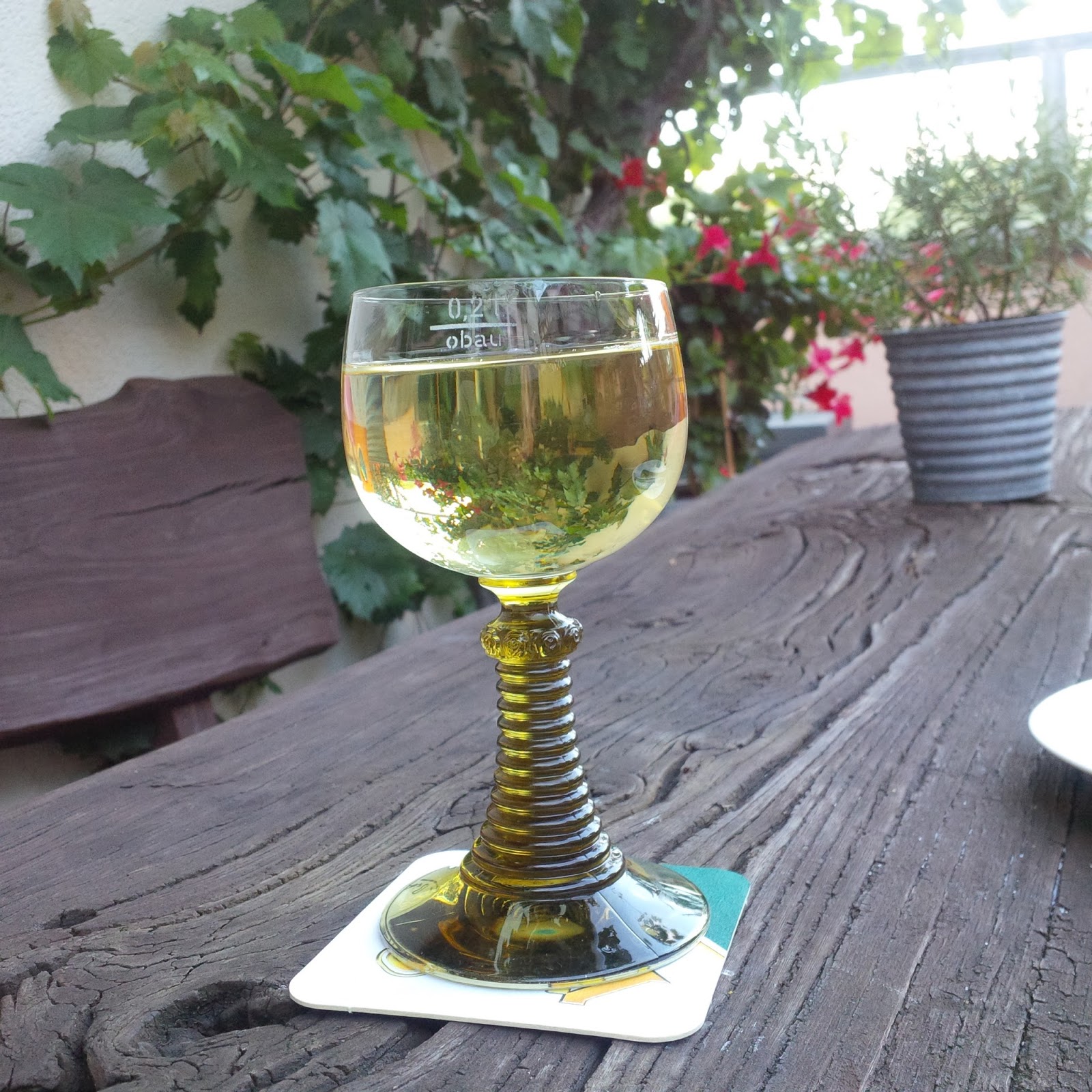
Here are some photos of the town and the vineyards....then photos of a modern Riesling glass and a traditional glass.